How is Tessera different from ChatGPT or other chatbots?
Chatbots are open-ended conversational assistants that can easily make mistakes or leak your data to public servers. Tessera is a private application that runs templates with defined, step-by-step rules. The AI only performs specific parsing tasks you approve, so it cannot act on its own.
What is a Supply Chain Risk automation template?
It is a pre-built workspace setup that automatically scans shipping routes and ports, cross-references delays with your spreadsheet of suppliers, and sends a simple alert to your inbox if a shipment is at risk, suggesting the best alternative ports.
Is my business data shared with anyone?
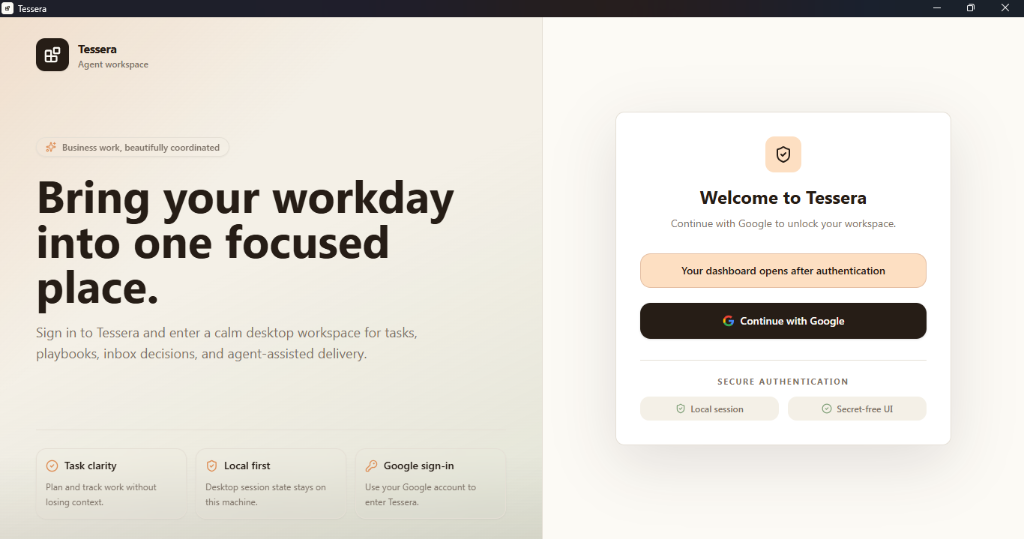
No. All databases, supplier files, activity logs, and passwords stay stored locally on your own computer. Tessera does not collect or upload your business data.
Do I need coding experience to use Tessera?
No coding experience is required. You can load pre-built templates for common tasks (like lead routing, invoice parsing, and port tracking) and customize guidelines using plain language.
How does Tessera connect to my existing business tools?
Tessera connects using secure local integrations. You can link local spreadsheets, email templates (Gmail/Outlook), search providers, and CRM software (like HubSpot) using system credentials safely encrypted inside your computer's built-in keychain.
What are the computer system requirements?
Tessera is lightweight and optimized for local desktop performance. It runs on Windows 10/11, macOS (Intel and Apple Silicon M1/M2/M3/M4), and standard Linux distributions. It runs efficiently in the background without slowing down your computer.
Can I share automation templates with my team?
Yes. Since Tessera templates are saved as simple files on your hard drive, you can easily share them with team members using standard shared folders (like Google Drive, OneDrive, or Dropbox) or sync them using private team repositories.
Is there a monthly subscription fee?
No. Tessera is a free, open-source desktop application. There are no monthly software subscriptions or licensing fees. You only pay directly to your chosen AI provider (such as OpenAI or Anthropic) for the raw tokens your local playbooks consume, with zero markups.
Can I self-host or contribute to Tessera?
Yes. Tessera is Apache 2.0 licensed, so you're free to fork it, modify it, and self-host it indefinitely. The source, issues, and pull requests are all public on GitHub — contributions and feature requests are welcome.
How do I backup my playbooks and history?
All your playbooks, local SQLite databases, style settings, and logs are stored inside a single directory (.tessera) on your computer. Simply copy this directory to an external drive or configure your automated backup software to include it.